
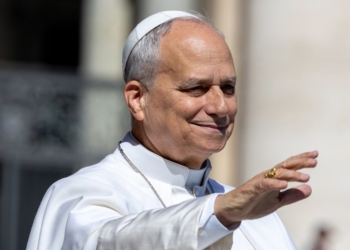




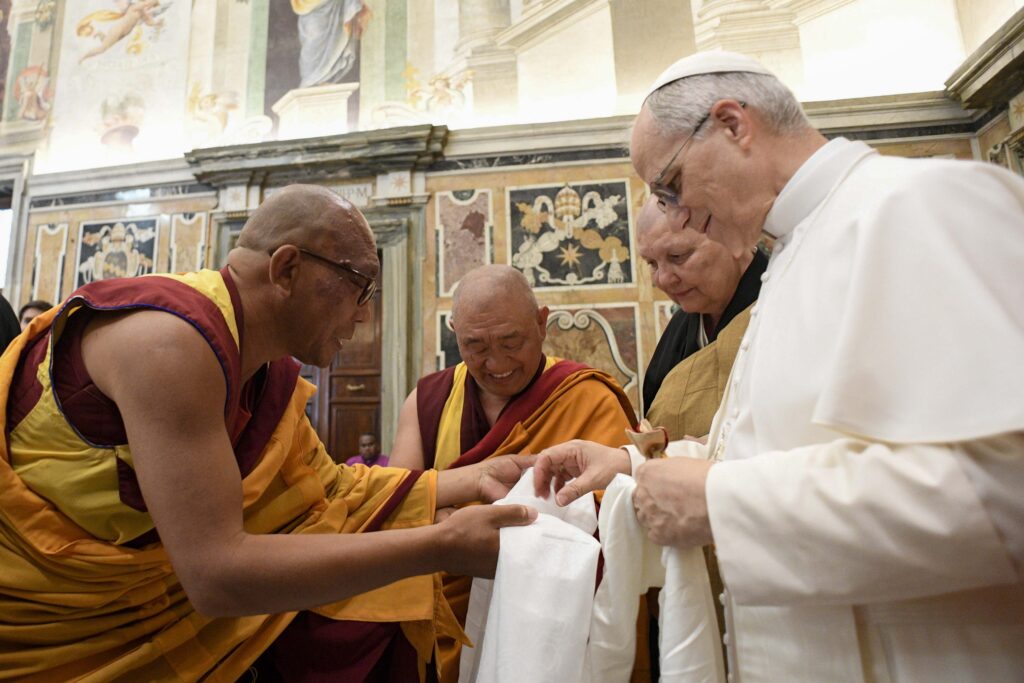
Pope Leo XIV began his papacy by meeting with representatives and leaders of various Christian and other faiths, emphasizing the importance of ecumenical and interreligious dialogue.
“Now is the time for dialogue and building bridges,” said Pope Leo at his meeting May 19 in Clementine Hall in the Apostolic Palace.
Among the delegates he met with were Orthodox Ecumenical Patriarch Bartholomew of Constantinople, Orthodox Patriarch Theophilos III of Jerusalem, and Catholicos Awa III, patriarch of the Assyrian Church of the East. Also in attendance were Anglican, Methodist and Lutheran leaders as well as representatives from the Jewish, Muslim, Buddhist, Sikh and Jain communities.
“As Bishop of Rome, I consider one of my priorities to be that of seeking the re-establishment of full and visible communion among all those who profess the same faith in God the Father, the Son and the Holy Spirit,” Pope Leo said.
He took note that full Christian unity must be based on the unity of faith. He also noted that it was fortuitous that his papal election took place in a year when Christians throughout the world are celebrating the 1,700th anniversary of the Council of Nicaea, which “represents a milestone in the formulation of the Creed shared by all churches and ecclesial communities.”
Pope Leo said planning is underway for him to visit Iznik, Turkey, the site of the original Nicaea, a trip that had been planned by Pope Francis and Patriarch Bartholomew.
Coming from the Augustinian Order, Pope Leo told the Christian leaders present, “Unity has always been a constant concern of mine.” He made reference to the motto he chose upon becoming a bishop in 2014: “In illo uno unum.” It’s an expression of Saint Augustine of Hippo that reminds us how we, too, although we are many, “In the One, we are one.”
He went on to say, “The more faithful and obedient we are to Jesus, the more united we are among ourselves. We Christians, then, are all called to pray and work together to reach this goal, step by step, which is and remains the work of the Holy Spirit.”
He added, “Aware, moreover, that synodality and ecumenism are closely linked, I would like to assure you of my intention to continue Pope Francis’ commitment to promoting the synodal nature of the Catholic Church and developing new and concrete forms for an ever-stronger synodality in ecumenical relations.”
It would seem that the good work of Pope Francis in recognizing the worth and dignity of every human being will continue under this pope’s pontificate.
Explaining that we are all brothers and sisters to one another, Pope Leo said, “The witness of fraternity, which I hope we will be able to show with effective gestures, will certainly contribute to building a more peaceful world, something that all men and women of goodwill desire in their hearts.”
“In a world wounded by violence and conflict, each of the communities represented here brings its own contribution of wisdom, compassion and commitment to the good of humanity and the preservation of our common home,” he said.
He explained that working together “free from ideological and political conditioning, we can be effective in saying ‘no’ to war and ‘yes’ to peace, ‘no’ to the arms race and ‘yes’ to disarmament, ‘no’ to an economy that impoverishes peoples and the Earth and ‘yes’ to integral development.”
Pope Leo emphasized the importance of interfaith dialogue and bridge-building, particularly with Jewish and Muslim communities, in the spirit of the Second Vatican Council’s “Nostra Aetate.” He also expressed gratitude for the contributions of other religious traditions toward peace and expressed hopes for collective action towards peace and integral development.
Father Joseph D. Wallace is diocesan director of Ecumenical and Inter-religious Affairs and pastor of Christ the Redeemer Parish, Atco.




 at the bottom and then tap “Add to Home Screen”
