



Christians celebrate the familiar season of Allhallowtide from Halloween (All Hallows’ Eve), through All Saints Day (Nov. 1) to All Souls Day (Nov. 2).
We remember the Church triumphant when memorializing the saints in heaven, and the Church suffering when we pray for the departed souls during the Commemoration of the Faithful Departed, or the Día de los Muertos. Sometimes lost amidst the shuffle of all of these cultural and seasonal rituals are other saints or Christian heroes who are revered during the same time of year.
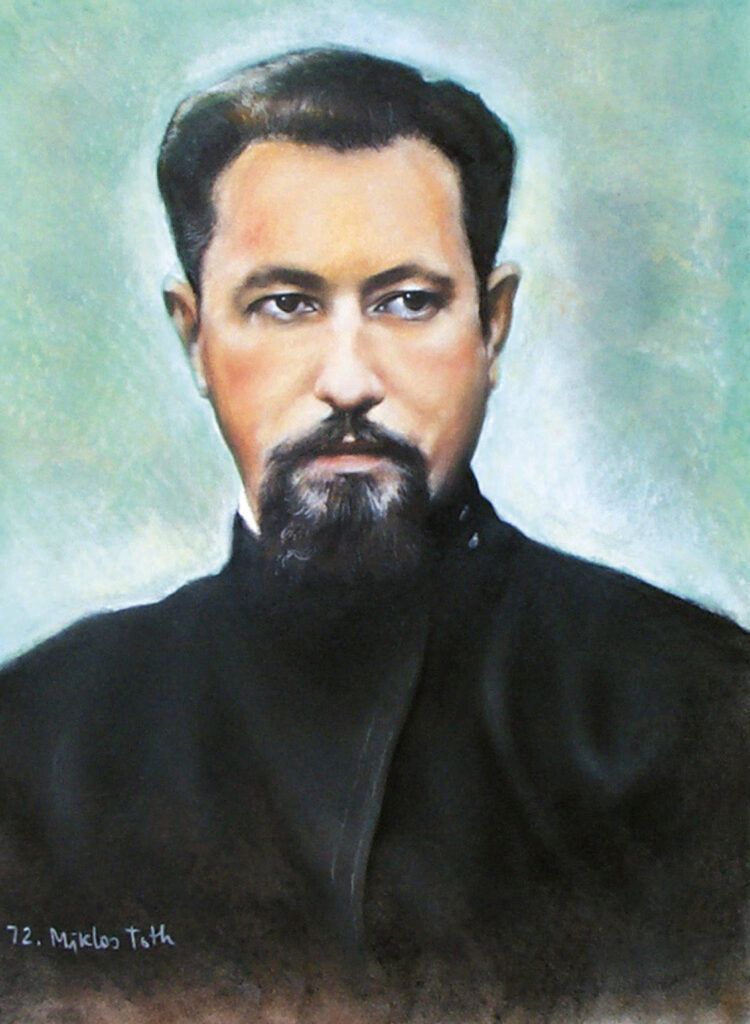
One such important figure to ponder in our day is Bishop Fedor Romža, sometimes Anglicized as Theodore Romzha, a hero of the Ruthenian Greek Catholic Church, born in current-day Ukraine in 1911. Fluent in both the Hungarian and Ukrainian languages, Theodore studied at the Pontifical Gregorian University and the Pontifical Collegium Russicum, the latter being the Catholic university and seminary in Rome dedicated to Russian culture and spirituality, and to training priests in the Byzantine-Slavonic rite.
Eventually he was named bishop of the Western Ukrainian city of Mukachevo, in the mother eparchy there. The local Ruthenian liturgy follows not the Latin rite, but the Byzantine one as outlined in the 1646 Union of Uzhhorod.
Romža’s pastoral leadership and solidarity with the poor in his care were viewed with deep suspicion by the anti-clericalist forces within the Stalinist Soviet Union, and in particular in the NKVD, the government department recognized as the Soviet Secret Police. In 1947, while ministering to his people in a horse-drawn carriage, he was intentionally ambushed by a military vehicle, in a crude attempt at faking an automobile accident. Badly wounded but alive, the bishop was taken to the local hospital. It was there that someone posing as a medical professional injected him with curare, a paralyzing poison, to ensure his death. He passed away sometime overnight on Oct. 31-Nov. 1, 1947. Thus, he is especially remembered this week.
The bishop was likely aware that his commitment to the faith would eventually lead to his assassination, and thus was proclaimed a martyr in 2001 by Pope John Paul II, who beatified him. Today, his relics rest in the Cathedral of the Exaltation of the Holy Cross in Uzhhorod, near the Ukrainian borders with Slovakia and Hungary.
It is important to remember that global Catholicism is represented in non-Latin churches in full communion with Rome from Ukraine to the Sinai Peninsula, from Albania to Lebanon, from India to Iraq, and from Egypt to Eritrea. Their development and rights are attended to by the Vatican’s Dicastery for the Eastern Churches, and each of them profess loyalty to the pope. When watching the opening ceremonies of a conclave, one can often identify the cardinals from these churches because of their quite distinctive garb and vestments, yet they participate as fully in the election of the next pope as those clad in red, who vastly outnumber them.
All 23 of these particular churches demonstrate their own theological, historical and liturgical identities, and as is the case with Bishop Romža, venerate their own local heroes.
There is broad diversity present in their major liturgical rites – Byzantine, Alexandrian, Armenian, East Syriac and West Syriac. In fact, the Western Church itself has approved liturgical rites in regular use beyond the familiar Roman one, most famously the Ambrosian (which is commonly celebrated in Milan and its surrounding dioceses) and the Mozarabic (which is celebrated in Toledo, Spain and other parts of the Iberian peninsula).
All of this serves to remind us that pluralism has been and remains a vital and essential part of contemporary ecclesiology, one that becomes distorted when uniformity becomes the dominant ambition for Church belonging or mode of interpreting ecclesial life. There are four Gospels, not one, and each tells a slightly different story of the always-mysterious Incarnation – a lesson our churches must continue to re-learn millennia after millennia.
The myriad saints and astonishingly dissimilar cloud of witnesses continue to remind us that being Catholic means first and foremost being authentically ourselves in a unique relationship with the God of history and of the cosmos, and yet always assessing that relationship with the sounding board of the wider believing community.
Originally from Collingswood, Michael M. Canaris, Ph.D., teaches at Loyola University, Chicago.




 at the bottom and then tap “Add to Home Screen”
