







Most medical professionals prefer to refer to the current pandemic as the “corona virus,” which is a descriptive rather than a socio-ethnic moniker. The word “corona” is taken from the Latin for “crown,” alluding to the pathogen’s microscopic pointy spikes that surround each molecule. Thus, in other languages, there are verbal connections that we lose in English. The Gospels, for instance, tell of the soldiers placing on Christ’s head a “corona de espinas” (a crown of thorns), an image that may come more easily to mind whenever a Spanish-speaker hears the disease name. We still use the related term “coronation” in English, though it’s less obvious.
There are also people in certain cultures whose baptismal (first) or familial (last) names are related to this original usage. Thus, there was a German musician named Corona Schröter and an Italian Renaissance painter named Leonardo Corona, and many of us are familiar with the beer and cigar that draw their branding from the term. Excusing the puns, there has also been a recent “spike” in internet searches of Saint Corona since some descriptions of her have gone “viral.”
Saint Corona, also sometimes called Stephanie (because Stephen/Stephanie is the Greek form of the Latin word corona), was reportedly a 16-year-old girl killed for the care she provided to a Roman soldier accused of converting to Christianity in one of the early waves of persecution. She is particularly honored in parts of Syria, Sicily, France and Germany, although not much is known about the historical veracity of the legends surrounding her. Her remains have been venerated for centuries both in Aachen Cathedral in Western Germany, where Charlemagne was entombed in 814, and in Anzu, Italy in the church of Santi Vittore e Corona.
Because Corona/Stephanie was reportedly tied to two bent palm trees that then sprung apart tearing her to shreds, she was adopted as the patron saint of lumberjacks and loggers. This was a common transference that occurred in Christian history where the manner of a person’s martyrdom came to have particular significance for guilds associated with specific professions. I will leave it to your imagination to contemplate the reasons why particular saints were adopted for eye doctors, dentists, mammogram technicians, butchers and leatherworkers. If you want to see artistic representations of these connections, visit the church of Saint Stefano Rotundo in Rome where they are traced in gory detail.
Saint Corona was not, as some have claimed, a patron saint long associated with infectious disease or pandemics. However, as professor and author Candida Moss has pointed out, these associations almost always grew up and developed centuries after the saints’ lives. Saint Edmund, for example, is revered as a powerful intercessor against plagues because his protection was invoked in regions of France in times of need 700 years after his death. Thus, the generative power of popular piety, which is the engine driving the faith of the church, may in fact today connect “Corona of the palms” with the “Corona of social distancing” for generations to come. Lex orandi, Lex credendi as the saying goes — “the law of prayer undergirds the law of belief.” Praying people, not official declarations, connect these witnesses to the faith to those in need of their intercession.
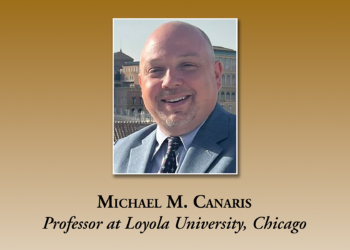
Originally from Collingswood, Michael M. Canaris, Ph.D., teaches at Loyola University, Chicago.




 at the bottom and then tap “Add to Home Screen”
