





While the pope has been suffering from sciatica and so had to cancel some events during this year’s week of prayer for Christian unity, he did take time to make public comments during his Sunday Angelus about a Nigerian immigrant named Edwin, who recently perished outside the Vatican on an unusually frigid Roman night.
Pope Francis said: “His story was added to that of many other homeless people who recently died in Rome in the same dramatic circumstances. Let us pray for Edwin.” He continued: “May we be reminded of the words of Saint Gregory the Great, who, when faced with the death of a mendicant from cold, said that Masses would not be celebrated that day because it was like Good Friday.
“Let us think about Edwin. Let us think of what this man, 46 years old, felt in the cold, ignored by all, abandoned, even by us. Let us pray for him.”
For some it brought to mind a real-life example of Evangelium Gaudium 53, where the pope asks rhetorically “How can it be that it is not a news item when an elderly homeless person dies of exposure but it is news when the stock market loses two points?”
These concerns continue to appear as cornerstone themes of the current pontificate: proximity, human fraternity, and a balancing of geopolitical commitment to the common good with an unmediated interpersonal culture of encounter, where two limited but transcendent human persons engage with one another, and are both transformed in the process.
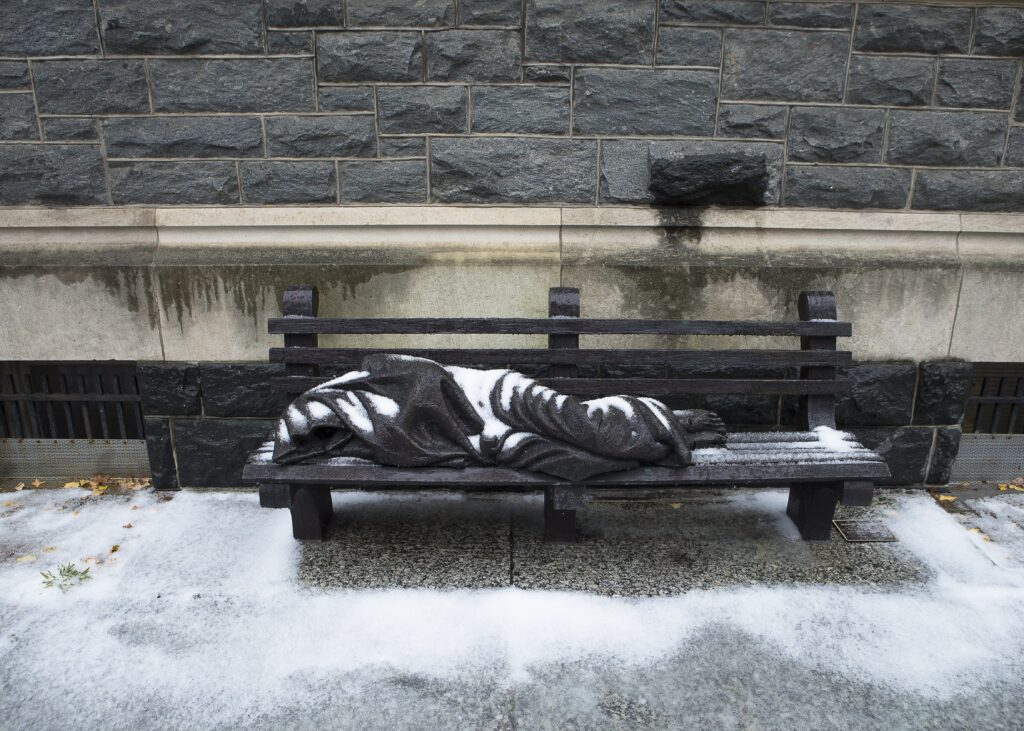
Perhaps no group of people is more victimized by the “globalization of indifference” than the unhoused, those too often treated by society as the most invisible among us. Here in Chicago, the Catholic Charities office is home to what they call a “visual ambassador”: a life-size bronze sculpture crafted by famed artist Timothy Schmalz of a body wrapped in a cloak with only the bare feet extending beyond the covering. When one approaches more intentionally, only then does he or she realize that the appendages bear the wounds of the stigmata, making clear that the forgotten figure is in fact the Son of Man, who unlike foxes and birds of the air, had nowhere to lay his head in this world. I pass the agency frequently, and I must confess that it strikes me the most powerfully when it is bitterly cold and covered in snow.
Pope Francis has often referred to three inalienable rights that are imperiled in our day: “tierra, techo, y trabajo.” In an attempt to keep the alliteration, it is often translated into English as “land, lodging, and labor.” It is clear that unseen forces, whether the external dehumanizing gears of economic oppression or the internal trauma of mental health systems’ failures, prevented Edwin from integrating this full human flourishing into his experience of desperation.
Yet, people around the world are being taught a new lesson through his terrible suffering, which must never be excused away. Often, those in situations of exclusion or marginalization have much to offer the society and church we all share with them, realities of which they are an indispensable part.
Our charge must never be interpreted solely as ladling them soup, or holy water. We must rather unceasingly permit their lives to interrogate our own. We must cry out on behalf of this single corpse, frozen and buried in a land far from his place of birth, not only to God in the trembling hope that Edwin may one day welcome us into the sumptuous banquet of eternal life, but also for justice and public reckoning for the systems that failed him here on earth. As the last line of the pope’s comment makes clear, this still too often includes our church.
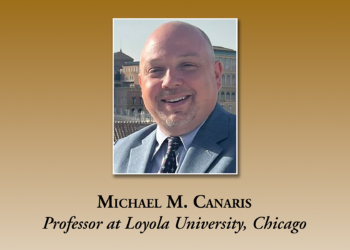
Originally from Collingswood, Michael M. Canaris, Ph.D., teaches at Loyola University, Chicago.




 at the bottom and then tap “Add to Home Screen”
