
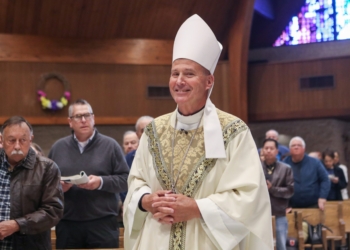




Bishop Douglas John Lucia of Syracuse, New York, has revived the ancient tradition of fasting and intentional prayer during the Advent ember days, with a particular attention to the hope for priestly vocations in his diocese. Though not commonly celebrated by contemporary American Catholics, the tradition has roots that date back for many centuries.
Ember days have nothing to do with ashes, but rather, like the German “Quatember,” are linguistic contractions of the Latin “quattuor anni tempora,” meaning “four annual seasons.” For sushi fans, it’s also supposedly where we get the word tempura, as Spanish and Portuguese Christian missionaries would abstain from meat and eat battered and fried fish and vegetables on those days while in the missions to Asia.
The celebrations were already well established by the time of Pope Gelasius (492-495 AD). It is here that we see early references to the ordination of clergy being held during these times.
The Advent ember days fall on the Wednesday, Friday and Saturday after Gaudete Sunday (i.e., the pink candle in the wreath). Historically, they were inaugurated by a Mass in the Church of Santa Maria Maggiore in Rome called the Missa Aurea, the “Golden Mass” that marked the Annunciation — along with March 25, exactly nine months before Christmas. Some scholars think this tradition was connected to the gilded letters of hand-written manuscripts where monks told the story of the Incarnation in the most expensive materials of the day. Elaborate gold liturgical vestments were also often used.
The ember days are placed throughout the year, not far from equinoxes, to celebrate the rhythms of agrarian life: planting, harvesting, pressing, etc. It’s clear that things like grapes, wheat, oil, as well as the movement of animals and fish, were life and death realities to ancient peoples, both Christian and not. Marking them was in some ways a precursor to our cultural imagination of dedicating a day to Thanksgiving, which after all is the literal meaning of the word “Eucharist.” They were regular traditions instituted to offer gratitude to God for nature’s bounty and to pray for protection and health in the coming year. Anthropologists recognize this eminently human tendency to exist across civilizations and geographical settings, along with things like death rituals and imploring supernatural prevention of natural disasters or weather devastations, like floods and droughts. As they did in so many other ways (including December celebrations of light and gift-giving), Christians simply “baptized” the pre-existing practice, making it a part of their own lived spirituality.
Though the Advent ember days are a somewhat lost liturgical tradition that prepared generations of Christians for the coming celebrations of the birth of Christ, the regular seasonal prayers of gratitude and intercession they represent are still very much a part of our lives as believers. The entire arc of the liturgical year — from Advent and Christmas, through Lent and Holy Week, and on to the great Marian feasts and commemorations of particular saints — draws us into contemplation and consecration of the passage of time, where there is a season for every purpose under the heavens (Eccl 3:1).
Originally from Collingswood, Michael M. Canaris, Ph.D., taches at Loyola University, Chicago.




 at the bottom and then tap “Add to Home Screen”
