





Some spiritual writers have looked at life on earth as essentially a “university of forgiveness,” where we are being schooled over the course of our moments or years on this planet to move ever closer toward the manifestation of divine compassion, that defining trait that literally means “suffering with” another.
If we are called to be perfect as our heavenly Father is perfect (cf. Mt 5:48), then such a calling obliges us to practice mercy in all of our dealings with one another. The etymological roots of mercy in the Latin word “misericordia” mean that we should be willing to share in the desolation or misery (“miser”) of another’s heart (“cor”). In that way, authentic mercy is not necessarily opposed to justice – as if one meant keeping someone in prison and another simply letting them out.
There is probably no greater challenge to human nature than to practice such sharing in another’s pain and dejection, since if left to one’s own devices, the human person shuns the suffering of self and others. Only with the gift of divine self-communication that Christians call “grace” can such a proclivity be overcome, and thus can he or she come to truly love another as one’s self.
But is this task only an earthly reality that ceases the instant when we die? Do those constituting the Church triumphant have anything further to do with forgiveness, or are they somehow “on the other side” of the experience altogether?
In John Thiel’s masterful book, “Icons of Hope: The Last Things in Catholic Imagination,” the author posits that in fact this task of forgiving continues even among the communion of saints in heaven. “This redemptive work begins in the earthly dimensions of the communion of saints,” he says, “but it can only be completed eschatologically, not only because forgiveness is so rare in life and humanity so sinfully broken, but also because the reconciliation that brings about the fullness of God’s kingdom is an activity that finally requires the cooperation of all the saints.”
Thiel roots this creative vision in what he calls a “noncompetitive” spirituality; that is to say one that doesn’t obsess over the distance between the merits of martyrs, ascetics, and spiritually advanced members of the Body of Christ and the rest of us flawed human sinners. “Forgiveness, by its very nature, is a noncompetitive practice that, when it succeeds, establishes a noncompetitive relationship. It defies the sinful parameters of competition that define all sorts of exchange in the world of the unforgiven and the unreconciled.”
Forgiveness in that way is a process, more than a singular act, and one that he imagines endures as the quintessentially saintly activity. “The more the saints together cooperate with the grace of forgiveness, both in this world and the next, the more any kind of hierarchy of discipleship loses definition in the reconciliation that binds the saintly communion.”
Since forgiveness is a relationship, and healthy relationships require reciprocity, then the traditional understanding of supplication and intercession still have a role to play in such speculation that the act of forgiving bridges the gap between the immanent and the transcendent, between our experience in this life and what we hope will be ours in paradise. The saints may be praising God, continuing to exist in a state of deep gratitude and beatific adoration, and yet remain engaged in the tireless work of reconciling people to God and to one another forever. Maybe their cooperative role to play in “making all things new” signifies an ongoing attention to the wounds and divisions that rent humanity from one another and from God. Thus, maybe the reconciling splendor of the Cross makes its way into heaven and isn’t discarded outside the Pearly Gates.
Thiel would seem to imply that the “university of forgiveness” doesn’t let out when we take our last breath. This analogy would seem to hold because as with our academic lives, any kind of “commencement exercises” really signify not a completion, but a new beginning opening us into a mysterious and as-yet-unforeseen future. So perhaps we are never really meant to graduate and move on from Forgiveness U, but rather called to keep it always as our ongoing “alma mater” (“nourishing mother”).
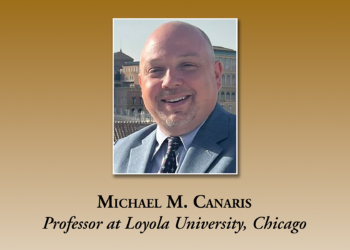
Originally from Collingswood, Michael M. Canaris, Ph.D., teaches at Loyola University, Chicago.



 at the bottom and then tap “Add to Home Screen”
