



Click Here to Subscribe

Photos: Father Naticchione First Mass

Bishop's Schedule

The Bishop’s Schedule, May 26 – June 2

by Staff Reports
May 21, 2026
0
ShareTweet

Featured

The Ascension, like death, not a departure, but a lifting

by Father Michael A. de Leon, AM
16 hours ago
0
ShareTweet

Bishop connects with staff, mission at SSJ Neighborhood Center

by Staff Reports
3 days ago
0
ShareTweet

Faith, Media and the Boardwalk

by Staff Reports
4 days ago
0
ShareTweet
  • Contact
  • Advertise
  • Subscribe
  • Home
Friday, May 22, 2026
Catholic Star Herald
  • News
    • From Bishop Williams
    • Parish Life
    • Diocesan News
    • Sports
    • Columns
      • From Bishop Sullivan
    • Obituaries
    • World/Nation
  • Catholic Schools
  • Español
  • Features
    • Special Supplements
      • Thank You Bishop Sullivan
      • Welcome Bishop Williams
      • Jubilarians
    • Entertainment
      • Movie Reviews
    • Photo Galleries
    • Talking Catholic
    • Latest Videos
    • Health and Wellness
  • Advertise
  • More
    • Classified
    • Subscribe
    • Contact Us
  • News
    • From Bishop Williams
    • Parish Life
    • Diocesan News
    • Sports
    • Columns
      • From Bishop Sullivan
    • Obituaries
    • World/Nation
  • Catholic Schools
  • Español
  • Features
    • Special Supplements
      • Thank You Bishop Sullivan
      • Welcome Bishop Williams
      • Jubilarians
    • Entertainment
      • Movie Reviews
    • Photo Galleries
    • Talking Catholic
    • Latest Videos
    • Health and Wellness
  • Advertise
  • More
    • Classified
    • Subscribe
    • Contact Us
No Result
View All Result
Catholic Star Herald
No Result
View All Result
Home Columns

The man who mastered the Rosetta Stone

Michael M. Canaris by Michael M. Canaris
August 24, 2017
in Columns, Science & Catholicism
Reading Time: 3 mins read
0
0
VIEWS
Share on FacebookShare on Twitter
The painting “Bonaparte devant le Sphinx” by Jean-Léon Gérôme depicts Napolean Bonaparte before the Sphinx in Egypt. His campaigns in Egypt and the Middle East gave rise to an enthusiastic cultural obsession with the ancient world throughout early 19th century Europe. The Rosetta Stone was discovered in the Nile Delta.
Jean-Francois Champollion by Léon Cogniet

What child has not had their imagination captured while wandering around a museum of mummies and sarcophagi and artifacts engraved with ancient hieroglyphics? Modern archeology in many aspects can be traced to this mysterious, if Orientalized and colonialist, gaze toward the shifting sands of Egypt. One figure who played a key role in the rise of the scientific discipline is French Catholic Egyptologist Jean-Francois Champollion (1790-1832).

Like Alexander the Great and Julius Caesar before him, Napoleon Bonaparte became entranced with a military conquest of the important economic crossroads where the Nile met the Mediterranean. His campaigns in Egypt and the Middle East gave rise to an enthusiastic cultural obsession with the ancient world throughout early 19th century Europe. Scholars of various nations sought to understand the Greek, Demotic, and hieroglyphic inscriptions found on a timeworn granite-like stone uncovered in the Nile Delta by French forces, today dated to the Fifth Ptolemaic dynasty in 196 B.C. Anyone who has visited the British Museum will recognize this rudimentary description of the famed Rosetta Stone.

When it was uncovered after almost 20 centuries, there was no one left on earth who could crack its mysterious code. Greek was easily understood, of course, but its relationships to the vernacular Demotic script and even more to the cartouches in the hieroglyphic section remained untranslated. No one knew if the sacred depictions represented letters (as Latin, Greek and English have) or pictographs (as some Chinese writing does).

Building on the work of British polymath Thomas Young, Champollion was able to unlock the stone’s secret, and thus open up the world of comprehending what the ancient Egyptians were recording on their monuments and papyri throughout the country.

He claimed, “It is a complex system, writing figurative, symbolic and phonetic all at once, in the same text, the same phrase, I would say in the same ‘word.’”

Interestingly, the interpretive key that allowed him to break the code was ancient Coptic, a language still used by Egyptian Christians today.

Certain moments of history represent a frontier where intensive paradigm shifts in knowledge occur that force us to re-examine our relationship with our identity-forming self-narratives (in which the community of the church constantly participates for Christians) and the world around us. Champollion undoubtedly lived in one of these moments.

His work started to make the Christian world think differently about the Flood and Exodus accounts along with other moments in salvation history, and was roughly coterminous with Darwin’s theories doing the same to the Genesis accounts. Such cultural plateaus and periods of explosive “jumps” have analogues in evolutionary theory, where they are referred to as “punctuated equilibria.”

We continue to wrestle with the ramifications of these discoveries into our day, and may be on the precipice of another such edge of rapid development in human knowledge with the growth of Artificial Intelligence technologies and ongoing genome studies. This will mandate concomitant ethical reflection to discern the difference between the human capacity to do something, on the one hand, and whether it should do so, on the other.

Champollion’s almost obsessive thirst for knowledge and its resultant scholarly assertions certainly made some Christians uncomfortable, as the literal timeline for the Biblical accounts was called into question.

The church had, however, long been fascinated with Egypt — a truth to which any tour through the Vatican museums can undoubtedly attest. Tradition holds, in fact, that one of the last things Saint Peter saw was not the shores of Galilee, but an obelisk brought from Egypt to the circus of Nero, and which still stands near the Via Della Conciliazione today.

Though it was not engraved with hieroglyphics as many of the other trophies of Roman conquest were, he certainly could not have fathomed the history of the already 1,200-year-old object he was seeing while hanging upside-down 2,000 years ago. But, thanks to the work of the Catholic Champollion, we can today more clearly hear the desert whispers from the land of Joseph, Manasseh and Moses, spiritual ancestors to Peter, and to us.

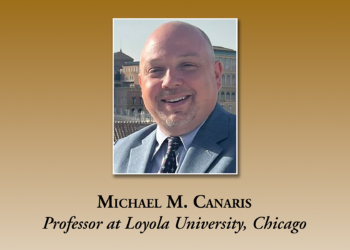
Collingswood native Michael M. Canaris, Ph.D., teaches at Loyola University, Chicago.
Previous Post

Connecting with the community through clay

Next Post

The Holy Family and true ownership of things

Related Posts

Columns

Pope Leo positioning the Church for an AI revolution

May 21, 2026
Columns

The Ascension, like death, not a departure, but a lifting

May 21, 2026
Columns

Stuck in a tight spot? Ask Mom, the intercessor

May 18, 2026
Columns

At the hour of any death, trust Our Lady’s promise

May 19, 2026
Facebook Twitter Instagram LinkedIn Youtube RSS

No Result
View All Result

Latest News

New Jerseyans urged to push for nonpublic school security funding

Faithful gather for spiritual renewal ahead of Pentecost

Father Naticchione celebrates first Mass in Ventnor

Bishop Dolan: Presence, connection, education keys to mental wellness

Bishop connects with staff, mission at SSJ Neighborhood Center

Latest Videos

View Ordination of Nickolas B. Naticchione in Cathedral

The legacy of Pope Francis

Pope Leo’s first Easter message

See livestream of Bishop Williams celebrating annual Chrism Mass

Pope Leo XIV’s first Palm Sunday

Around the Diocese

  • The Diocese of Camden
  • Talking Catholic Podcast
  • Catholic Charities
  • Advertise
  • Catholic Cemeteries
  • VITALity Healthcare Services
  • Housing Services
  • Camden Deacon
  • Camden Priest
  • South Jersey Catholic Schools
  • Man Up South Jersey
  • Catholic Business Network

Additional Resources

  • New Jersey Independent Victim Compensation Fund
  • Quick Guide to Reporting Sexual Abuse
  • List of Credibly Accused Priests and Parish Resources
  • Bishop’s Commission Report on Catholic Schools

Reorganization of the Diocese

  • Chapter 11 Claims filing info
  • Chapter 11 Prime Clerk Filing

© All Rights Reserved | May 22, 2026 | Catholic Star Herald of the Diocese of Camden

En español/Sa Tagalog

Add the Catholic Star Herald to your home screen

For Android users(Chrome) tap the at the top right vertical 3 dots then tap “Add to Home Screen”

For iPhone tap:at the bottom and then tap “Add to Home Screen”

  • This field is for validation purposes and should be left unchanged.

If you need assistance with submitting your subscription, please call Neal Cullen at 856-583-6139, or email Neal.Cullen@camdendiocese.org

No Result
View All Result
  • News
    • From Bishop Williams
    • Parish Life
    • Diocesan News
    • Sports
    • Columns
      • From Bishop Sullivan
    • Obituaries
    • World/Nation
  • Catholic Schools
  • Español
  • Features
    • Special Supplements
      • Thank You Bishop Sullivan
      • Welcome Bishop Williams
      • Jubilarians
    • Entertainment
      • Movie Reviews
    • Photo Galleries
    • Talking Catholic
    • Latest Videos
    • Health and Wellness
  • Advertise
  • More
    • Classified
    • Subscribe
    • Contact Us

© All Rights Reserved | May 22, 2026 | Catholic Star Herald of the Diocese of Camden