




By Maria Wiering, OSV News
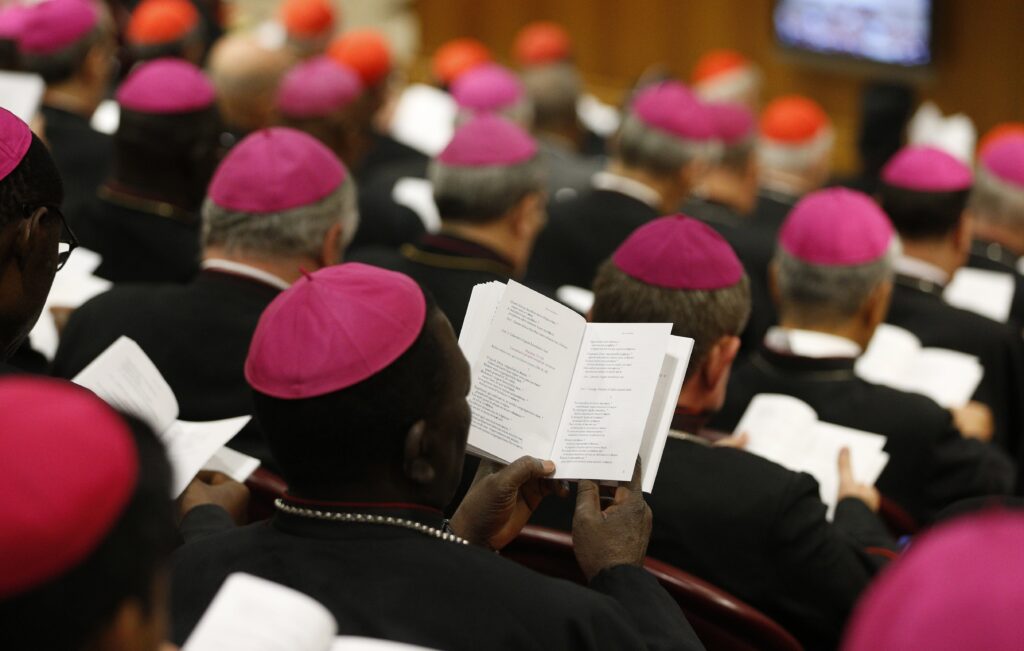
(OSV News) — The eyes of the Catholic world turn to Rome Oct. 4, as the worldwide Synod of Bishops convenes on the feast of St. Francis of Assisi to focus on “synodality” and understanding what it means in terms of “communion, participation and mission” in the church. Here’s what it is, how we got here and what to expect.
- The Synod on Synodality is three years in the making.
Pope Francis announced in March 2020 (at the height of the COVID-19 pandemic, especially in Italy) that the next Synod of Bishops would be held in October 2022 on the theme “For a synodal Church: communion, participation and mission,” which quickly became known as the “Synod on Synodality.” In May 2021, he postponed the two-part meeting to 2023 (with a second gathering in 2024), due in part to the pandemic, and announced that it would be preceded by a two-year process.
That decision reflected Pope Francis’ vision for the Synod of Bishops outlined in the 2018 apostolic constitution “Episcopalis Communio,” including what Cardinal Mario Grech, the general secretary for the Synod of Bishops, described at the time as “transforming the Synod from an event into a process.” Pope Francis officially opened the “synodal path” with a Mass Oct. 10, 2021, with dioceses around the world following suit.
2. Synodality is “the action of the Spirit in the communion of the Body of Christ and in the missionary journey of the People of God.”
Despite the long history of synods in the church, the term “synodality” is relatively recent, emerging in church documents about two decades ago. In 2018, the topic was addressed by the International Theological Commission, which defined it as “the action of the Spirit in the communion of the Body of Christ and in the missionary journey of the People of God.”
Synodality was also a topic of conversation at the 15th Ordinary General Assembly of the Synod of Bishops on the theme “Young People, Faith and Vocational Discernment” that took place in 2018.
In the Synod on Synodality’s “vademecum,” an official handbook issued in September 2021, “synodality” is described as “the particular style that qualifies the life and mission of the Church, expressing her nature as the People of God journeying together and gathering in assembly, summoned by the Lord Jesus in the power of the Holy Spirit to proclaim the Gospel,” adding, “Synodality ought to be expressed in the Church’s ordinary way of living and working.”
In his homily for the Mass opening the synod process, Pope Francis said, “Celebrating a synod means walking on the same road, walking together.” He said that when meeting others, Jesus would “encounter, listen and discern,” and those verbs “characterize the synod.”
“The Gospels frequently show us Jesus ‘on a journey’; he walks alongside people and listens to the questions and concerns lurking in their hearts,” he said. “He shows us that God is not found in neat and orderly places, distant from reality, but walks ever at our side. He meets us where we are, on the often rocky roads of life.”
He continued: “Today, as we begin this synodal process, let us begin by asking ourselves — all of us, pope, bishops, priests, religious and laity — whether we, the Christian community, embody this ‘style’ of God, who travels the paths of history and shares in the life of humanity. Are we prepared for the adventure of this journey? Or are we fearful of the unknown, preferring to take refuge in the usual excuses: ‘It’s useless’ or ‘We’ve always done it this way’?”
3. A synod is a meeting of bishops. It has ancient roots in the Catholic Church’s history and continuity in the Eastern Churches, but declined in the Latin Church. The modern Synod of Bishops was instituted near the end of Vatican II.
“Synod” has been historically interchangeable with “council,” such as the churchwide Council of Nicea or the Council of Trent, or more localized meetings, such as the Plenary Councils of Baltimore, which brought the U.S. bishops together in 1852, 1866 and 1884. The late Jesuit Father John W. O’Malley, a theologian at Georgetown University, noted in a February 2022 essay for America magazine that local councils declined in use following the First Vatican Council, which defined papal primacy, but they didn’t die out: “One of the first things that the future Pope John XXIII did when he became patriarch of Venice was to call a diocesan synod,” he wrote.
The idea for a permanent bishops’ council surfaced during the Second Vatican Council, and in 1965 St. Paul VI established the Synod of Bishops with “the function of providing information and offering advice.” “It can also enjoy the power of making decisions when such power is conferred upon it by the Roman Pontiff; in this case, it belongs to him to ratify the decisions of the Synod,” St. Paul VI wrote.
4. The Synod on Synodality is the 16th Ordinary Synod since the global Synod of Bishops’ institution.
Three extraordinary general assemblies have also been held, including in 2014 to complete the work of the 2015 ordinary general assembly on the family. An additional 11 special Synods of Bishops have been held to address issues facing a particular region. Among them was a special synod on America in 1997 and one on the Amazon region in 2019. Synods have regularly resulted in the pope, who serves as the synod president, writing a post-synodal apostolic exhortation.
5. Preparations for the Synod on Synodality sought to be the most extensive ever, with an invitation to every Catholic to provide input.
An unprecedented worldwide consultation occurred at the diocesan/national and continental levels. The synod’s two-year preparation process invited all Catholics worldwide to identify areas where the church needed to give greater attention and discernment. That feedback was gathered and synthesized by dioceses and then episcopal conferences, before being brought to the continental level. The syntheses from episcopal conferences and continental-level meetings were shared with the Holy See, and they informed a working document known as an “Instrumentum Laboris” for the general assembly’s first session. The document’s authors describe it as “not a document of the Holy See, but of the whole Church.” However, the U.S. Conference of Catholic Bishops’ report indicates that only about 700,000 Catholics in the U.S. participated, representing just over 1% of the U.S. Catholic population of 66.8 million.
6. The Synod on Synodality’s objective boils down to answering a two-part question.
According to the vademecum, “The current Synodal Process we are undertaking is guided by a fundamental question: How does this ‘journeying together’ take place today on different levels (from the local level to the universal one), allowing the Church to proclaim the Gospel? and what steps is the Spirit inviting us to take in order to grow as a synodal Church?”
The working document released in June to guide general assembly participants includes many other reflection questions; but it particularly asks participants to reflect on these priorities, guided by its focus on communion, participation and mission: “How can we be more fully a sign and instrument of union with God and of the unity of all humanity?”; “How can we better share gifts and tasks in the service of the Gospel?”; and “What processes, structures and institutions are needed in a missionary synodal church?”
7. For the first time ever, non-bishops — including lay men and women — have a vote in the synod.
The synod’s general assembly includes more than 450 participants — 363 of whom are voting members — with leaders from the Vatican curia and episcopal conferences. More than a quarter of synod members are non-bishops, including laypeople, who for the first time will have a vote during synod deliberations. A deliberate effort was made to include women and young adults. As of July 7, when the Vatican released the initial list, the number of voting women was the same as participating cardinals: 54. The list was subject to change ahead of the synod, organizers said.
In previous synods, some non-bishop participants held the non-voting role of “auditor,” which has been eliminated at this assembly, although some attendees will be non-voting observers, called “special envoys,” or non-voting facilitators or advisers.
The presence of “non-bishops,” according to Cardinal Jean-Claude Hollerich, the synod’s general relator, in a letter published at the time the change was announced, “ensures the dialogue between the prophecy of the people of God and the discernment of the pastors.”
8. More than 20 Catholics from the United States have been invited to participate.
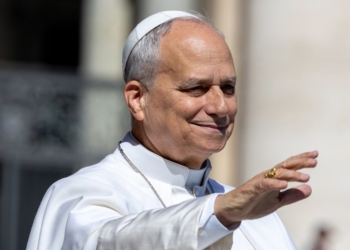
Participating American bishops chosen by Pope Francis are Cardinal Blase J. Cupich of Chicago, Cardinal Wilton D. Gregory of Washington, Archbishop Paul D. Etienne of Seattle, Cardinal Seán P. O’Malley of Boston and Cardinal Robert W. McElroy of San Diego, California.
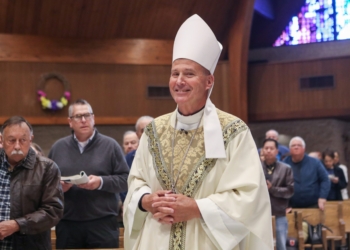
Additional bishop-delegates selected by the USCCB and confirmed by Pope Francis are Bishop Daniel E. Flores of Brownsville, Texas; Cardinal Timothy M. Dolan of New York; Bishop Robert E. Barron of Winona-Rochester, Minnesota; Bishop Kevin C. Rhoades of Fort Wayne-South Bend, Indiana; and Archbishop Timothy P. Broglio, who leads the U.S. Archdiocese for the Military Services, and serves as USCCB president.
American prelates Cardinal Joseph W. Tobin of Newark, New Jersey, and Cardinal Kevin J. Farrell, formerly the bishop of Dallas, are also delegates by nature of prior papal appointments. Cardinal Tobin is an ordinary member of the Synod of Bishops and Cardinal Farrell is prefect of the Dicastery for the Laity, Family and Life.
Pope Francis also nominated synod member Jesuit Father James Martin, editor-at-large for America magazine and founder of Outreach, a ministry for Catholics who identify as LGBTQ+.
Other U.S. delegates were nominated by the USCCB and confirmed by the pope. They include: Richard Coll, the executive director of the USCCB’s Department of Justice, Peace and Integral Human Development; Cynthia Bailey Manns, director of adult faith formation at St. Joan of Arc Parish in Minneapolis; Father Iván Montelongo of El Paso, Texas; Wyatt Olivas, a student at the University of Wyoming in Laramie, Wyoming; Julia Oseka, a Polish student at St. Joseph’s University in Philadelphia; and Sister Leticia Salazar, a member of the Company of Mary, Our Lady and chancellor of the Diocese of San Bernardino, California.
USCCB-nominated delegates participated in the continental synod, and Coll, Bishop Flores and Sister Salazar were members of the 18-person North American Synod Team that prepared the North American continental synod report for the U.S. and Canada. Bishop Flores has been named one of nine delegate presidents of the assembly.
Sister Maria Cimperman, a member of the Society of the Sacred Heart and theologian at Catholic Theological Union in Chicago, and American Jesuit Father David McCallum, executive director of the Discerning Leadership Program in Rome, are among the 57 non-voting experts.
9. In the U.S., the meeting has been a source of great expectation and great apprehension.
The synod has inspired both great praise and deep criticism for its approach, including allowing laypeople to vote; its subject matter, which includes controversial topics such as leadership roles for women, ministry to Catholics who identify as LGBTQ+, and the relationship between laypeople and clergy. At least one cardinal expressed concern that the meeting could lead to confusion and error in church teaching.
However, Bishop Flores, speaking recently with OSV News, said the meeting aims to better understand people’s reality so it can better minister to them. “We can’t respond with the Gospel if we don’t know what the reality they’re facing is,” he said of people, especially those on margins and in difficult situations.
10. October’s meeting is just the beginning.
In an unusual move, the synod general assembly has been divided into two sessions, with the first Oct. 4-29, and the second planned for October 2024. The decision, announced in October 2022, has parallels to the Synod of Bishops on the Family, which met in 2014 for an extraordinary general assembly of the Synod of Bishops, and then continued its work the following year as an ordinary assembly. The work of both meetings culminated in the post-synodal apostolic exhortation “Amoris Laetitia” (“The Joy of Love”), released in 2016.
Prior to the synod, Pope Francis presides over an ecumenical prayer vigil in St. Peter’s Square Sept. 30. Synod participants attend a retreat Sept. 30-Oct. 3 in Sacrofano, about 16 miles north of Rome. The retreat includes morning meditations — offered by Dominican Father Timothy Radcliffe of the United Kingdom and the Benedictine Rev. Mother Maria Ignazia Angelini of Italy — afternoon small-groups and Mass.
Meanwhile, the Taizé community and other organizations have organized a meeting in Rome that weekend called “Together — Gathering of the People of God” for young people to pray for the synod.
The synod’s general assembly opens Oct. 4 with a papal Mass that includes the new cardinals created at a Sept. 30 consistory. Among them is expected to be Archbishop Christophe Pierre, apostolic nuncio to the United States.



 at the bottom and then tap “Add to Home Screen”
