





PLEASANT MILLS – Forty-two miles from Philadelphia and nine miles from Hammonton, on a bucolic parcel of land on the west bank of the Mullica River, 70 clergy and laity gathered this month to honor the past and pray for the present.
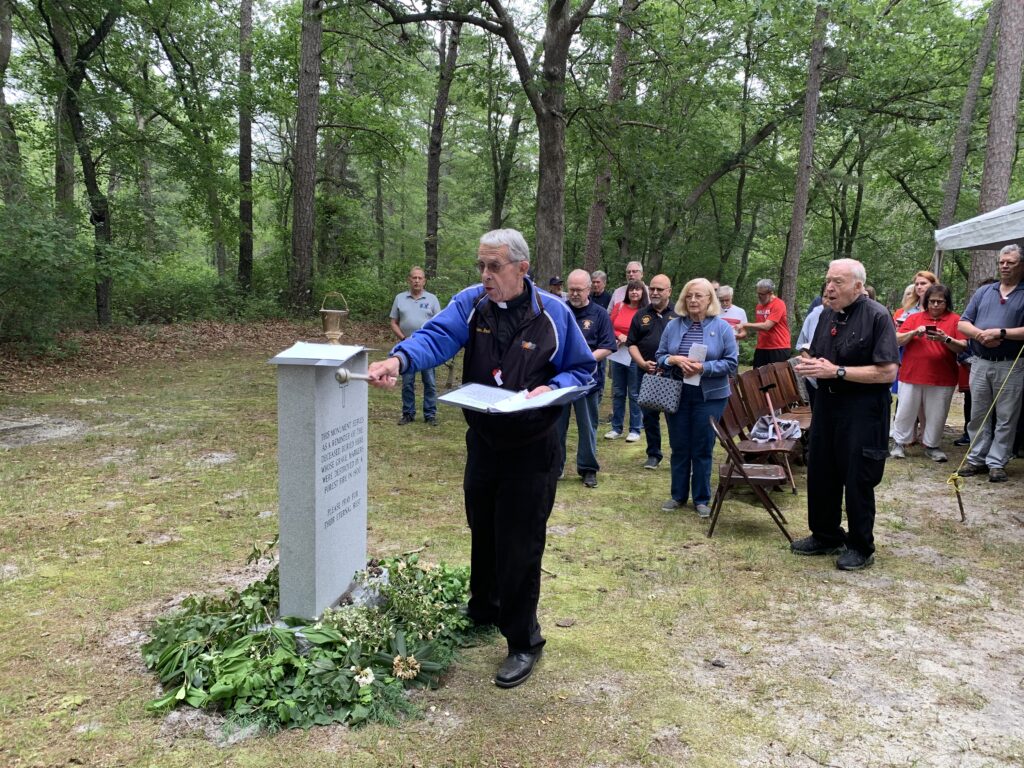
On Flag Day, June 14, priests, veterans, Knights of Columbus, archaeologists, historians and volunteers celebrated the 25th annual Blessing of the Flag and the Mullica River at Saint Mary’s of the Assumption Cemetery. There, they recalled the site’s history as a home for 19th century Catholics.
“We will forget unless we remember,” said Father James Betz, a retired priest and military chaplain of the Diocese of Camden who, with retired priest Father Neal Dante, led the ceremonies for the site.
Saint Mary’s cemetery, reported as the oldest Catholic cemetery in southern New Jersey, is located among what was believed to be the first Catholic church south of Trenton – and the third in the state.
In the early 19th century, Catholic settlers in the area were few and far between. Many worked at Batsto Furnace and Iron Works, but could only practice their faith when a priest from Philadelphia could visit faithful in their Pleasant Mills homes.
Recognizing a need for his Catholic employees, Jesse Richards, a Protestant who owned Batsto Furnace and Iron Works, donated this property in 1826.
After collecting enough funds – some reportedly from Richards, as well – Saint Mary’s of the Assumption, more commonly known as Saint Mary’s in the Pines, was established, with Father Edward R. Mayne as its first pastor. With the church under the bishop of Philadelphia, Bishop Francis Kenrick dedicated the wooden frame structure on Aug. 15, 1830.
After Richards’ death in 1854, the furnace and iron work dried up, and workers left the area to find other employment, causing church attendance to drop. By 1865, the church was boarded up, and in 1885, it became associated with Saint Joseph Church, Hammonton, then part of the Diocese of Trenton.
Around 1900, a forest fire destroyed the church, but its graveyard remains, with its stone markers dating as early as 1835, and the latest 1906.
Among those buried in the cemetery are Franz and Mary Froehlinger, parents of the late Joseph Fralinger, originator of Atlantic City’s famous Fralinger’s Salt Water Taffy.
“We hold this event so people would understand the history here, honor the people buried here, and pray for the town and the river,” said Ron Lischak, who is one of the volunteers who increased awareness for the cemetery a quarter-century ago.
He and others were successful in cleaning up the growing vegetation and placing pavers on the original location of the church, with the surviving stone foundation marking its perimeter.
A recent ground penetration radar survey of the cemetery, conducted by the Pinelands Commission with a grant from the National Park Service, found possible unmarked burials, a likely sign that wooden grave markers were destroyed in the forest fire.
Thus, the volunteers secured a new stone monument that was unveiled and blessed June 14. Asking God that the cemetery be a place of rest and hope, Father Dante prayed that the site would “be a comfort to the living, a sign of their hope for unending life. May prayers be offered here continually in supplication for those who sleep in Christ.”
Father Dante also blessed a wreath specifically made for the occasion out of plants native to the area – a wild Catawba grape vine, wild yarrow root and rambling rose.
“Open our hearts to your presence, our ears to your truth and our eyes to the sacred trust of creation and life, which we share with all that you have made,” Father Dante implored.
Each attendee was invited to impart their own blessing on the wreath, in petition for the safety of the river and those who use it. The wreath was then tossed into the Mullica River behind the cemetery by Steve Capuccio, Past Grand Knight for the Knights of Columbus Pallotti Council 3741 out of Hammonton.
Paul Purcell, who along with his wife, Mary Pat, is a longtime attendee of the annual gathering –there is also an All Souls Day blessing at the cemetery in November – explained that “it’s hard not to fall in love with this place.”




 at the bottom and then tap “Add to Home Screen”
