




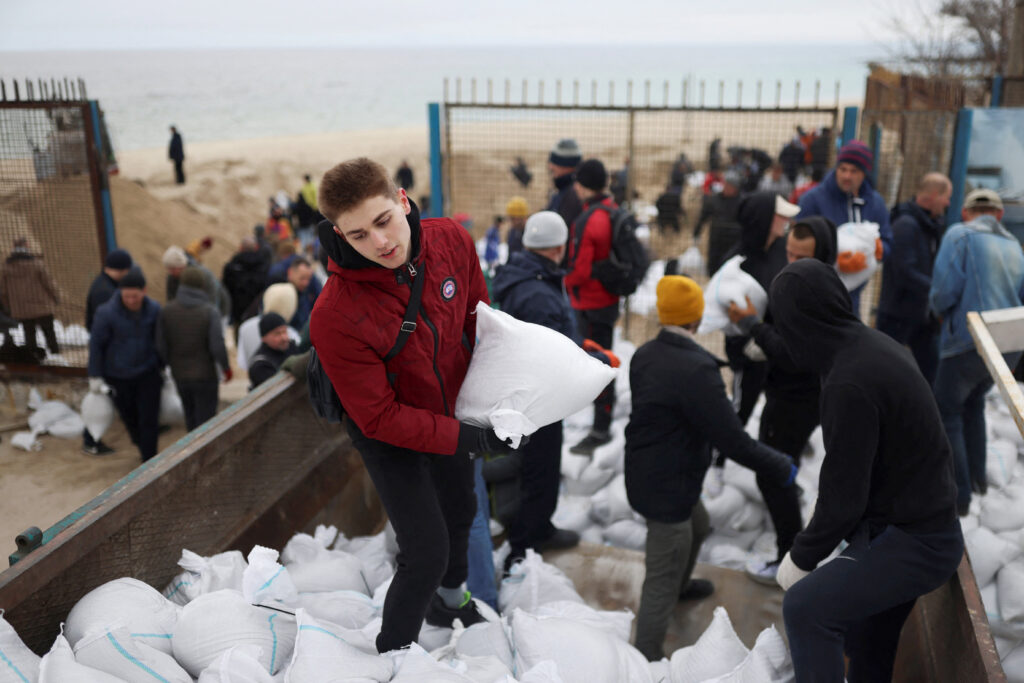
After receiving inquiries about my last column – which reported on the religious underpinnings of the recent invasion by Russia into neighboring former Soviet states – I thought I would add a little more information.
It is a complicated history that has added in part to the religiously emotional claims by the Russian Orthodox Church that both Crimea, violently annexed by Russia in 2014, and Ukraine should continue under the authority of the Moscow Patriarchate. Religion has played a key role in the present-day claims by Russia that both Crimea and Ukraine belong to Russia. Orthodox Christian nationalism has been growing steadily since the collapse of the USSR in the 1990s.
The relationship between the Russian Orthodox Church and the Russian government has been evident in ways such as the persistent refusal by the Patriarch of Moscow to allow the Bishop of Rome to ever set foot on Russian soil. Under advice from the Patriarchate of Moscow, the Russian government forced the Salvation Army from Moscow in 2001, as well as other Protestant missions. The Patriarchate has also been instrumental in the government crackdown on gay people in Russia. The Moscow Patriarchate has aided and abetted the annexation of both Crimea and Ukraine as part of the so called “Cradle of Russian Christianity.”
Russians consider the conversion of Prince Vladimir in 988 AD from Slavic paganism to Christianity as one of the pivotal moments in Russian history. His baptism in the ancient Greek colonial city of Chersonesos by the Byzantine emperor is described by early Russian nationalist historians as “the most important event in the history of all Russian lands,” because the conversion “began a new period of our existence in every respect: our enlightenment, customs, judiciary and building of our nation, our religious faith and our morality.”
After the fall of Rome to the Visigoths in 410 AD and then the Byzantine Empire to the Ottomans in 1453 AD, early Russian tsars who claimed divine right to their thrones, as well as later-day Russian state theorists, promoted Moscow as the “Third Rome,” claiming it was up to Moscow to preserve the “one true faith.” Eventually, many Western governments separated church from state; Russia moved in the opposite direction. Nicholas I, 1825-1855, the tsar famous for suppressing the Hungarian Revolution in 1848 and fighting the Crimean War, 1853, summarized Russia’s church-state identity in his phrase: “Orthodoxy, Autocracy, Nationality.” This remained the Russian identity until the Russian Revolution of 1917.
Following the revolution, one of the new Soviet government’s objectives was the elimination of existing religion, and the prevention of the establishment of any religion, with the goal of establishing state atheism. As for the Russian Orthodox Church, Soviet authorities did all they could to control it, and at times to exploit it for their own purposes. Eventually, the Soviets sought to control the Orthodox Church by assigning clergy who were obedient to the state and who were sometimes infiltrated by KGB agents. The Orthodox Church of Russia became useful to the government as it espoused and propagated Soviet foreign policy, and furthered the russification of non-Russian Christians, such as Orthodox Ukrainians and Belarusians. Following the collapse of the USSR, the Russian Orthodox Church experienced greater freedoms and worked closely with the new emerging government.
The present leader of the Russian Orthodox Church, Patriarch Kirill, is supporting the right of Russia to claim both Crimea and Ukraine. In a recent sermon given earlier this month at the Cathedral of Christ the Savior in Moscow, he claimed the invasion of Ukraine was about stemming the spread of “gay pride parades” from the West, and described the war as “a struggle that has not a physical but a metaphysical significance,” adding that “we are talking about something different and much more important than politics. We are talking about human salvation.” He sees the war as a culture war between conservative religious traditionalism versus liberalism.
The Moscow Patriarch and his supporters should be ashamed to condone and support this wonton slaughter of innocent human beings in Ukraine. Let us continue to pray for peace and the right to self-determination in Ukraine!
Father Joseph D. Wallace is diocesan director of Ecumenical and Inter-religious Affairs and pastor of Christ the Redeemer Parish, Atco.



 at the bottom and then tap “Add to Home Screen”
