





It’s not every day that someone wakes up and says, “I wonder what I should say to Pope Francis this afternoon, and I wonder what he’ll say in response to my suggestions?”
But that’s precisely what Aleja Sastoque Luna had to weigh on the morning of Feb. 24. I have served as an academic mentor and adviser to Aleja since she arrived from Colombia to do graduate studies at Loyola University Chicago. Today, she’s not only one of my prized students, but also a colleague, as she has recently been hired by our Campus Ministry Offices. She is also a good friend.
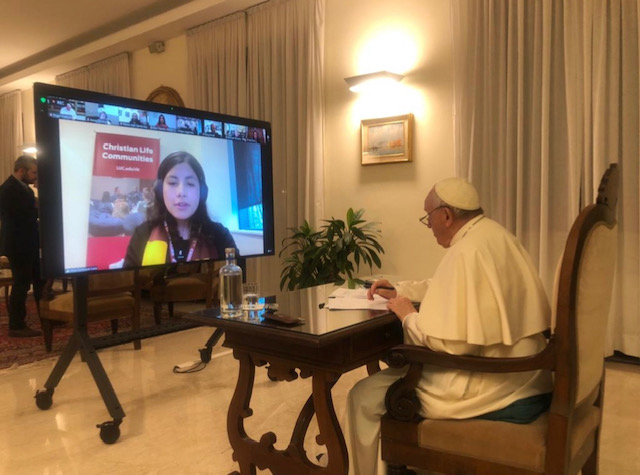
Loyola worked with Dr. Emilce Cuda, the head of the Vatican’s Pontifical Commission for Latin America, to organize a meeting of over 100 students from 21 countries to form a cohort for a launch of what has been termed the Building Bridges Initiative. The working groups elected representatives from around the globe to present their ideas to the Holy Father in an attempt to model the principle of synodality, which he continues to encourage. Aleja was nominated by the other students to be one of these conversation partners.
Aleja told me how the event was both a challenge and unique opportunity. “It was an exciting and difficult exercise. We were tasked with proposing concrete, specific projects to the Holy Father. I felt the Holy Spirit acted and inspired us on different topics, as our conversations centered on the effects of migration on realities like global warming, economics, politics, etc.
“Additionally, we also made reference to specific issues in the Catholic Church,” she said. “For example, the change that is needed in the formation of priests and different religious communities, and the lack of spaces for young people like us to be able to express ourselves and generate changes in our Church. We even proposed that instead of closing or merging parishes, they let us develop our projects to benefit migrants from our professions in these physical locations in new ways. These meetings across continents gave rise to many projects that we hope we can carry out with the help of the different universities involved. We know this is only the first step in what will be a much wider and longer Building Bridges Initiative.”
“Of course, the meeting with Pope Francis was surreal,” she continued. “Each one of us who had the opportunity to express ourselves in front of the pope presented not only the project, but also the dreams and experiences of all the people who have been part of this initiative. Each presentation was different, since we have different realities and contexts, but we were invited as all sharing something in common: some connection to or specialization in migration in the American hemisphere. As we watched the pope take notes on our interventions, we became aware that he was attentive to every word of each student. He responded with answers from his own life experience, and best of all, addressed each one of us by name. He made the meeting personal and unique.
“I was honored when the pope singled out my comments and thanked me directly, as I had doubted whether to offer more academic thoughts, or instead to put forward more human, personal ones. But my professors and my colleague Keiry encouraged me to trust my instincts,” Aleja said. Though other students were courageous in their honesty and even in offering critiques, I think maybe I was the only one who risked such personal vulnerability, but I tried to do so with humility and serenity.”
She concluded, “This meeting has given me hope and enthusiasm to continue fighting for a different Church. A Church that, as the Pope said, is a pilgrim Church in the street, not static within structures and walls, a ‘museum Church’ as he called it. We want to continue building these bridges from our projects; we want to continue walking together, keeping not only our heads held high but also our roots, our cultures, and most importantly, our fight for the dignity of every human being.”
Originally from Collingswood, Michael M. Canaris, Ph.D., teaches at Loyola University, Chicago.



 at the bottom and then tap “Add to Home Screen”
